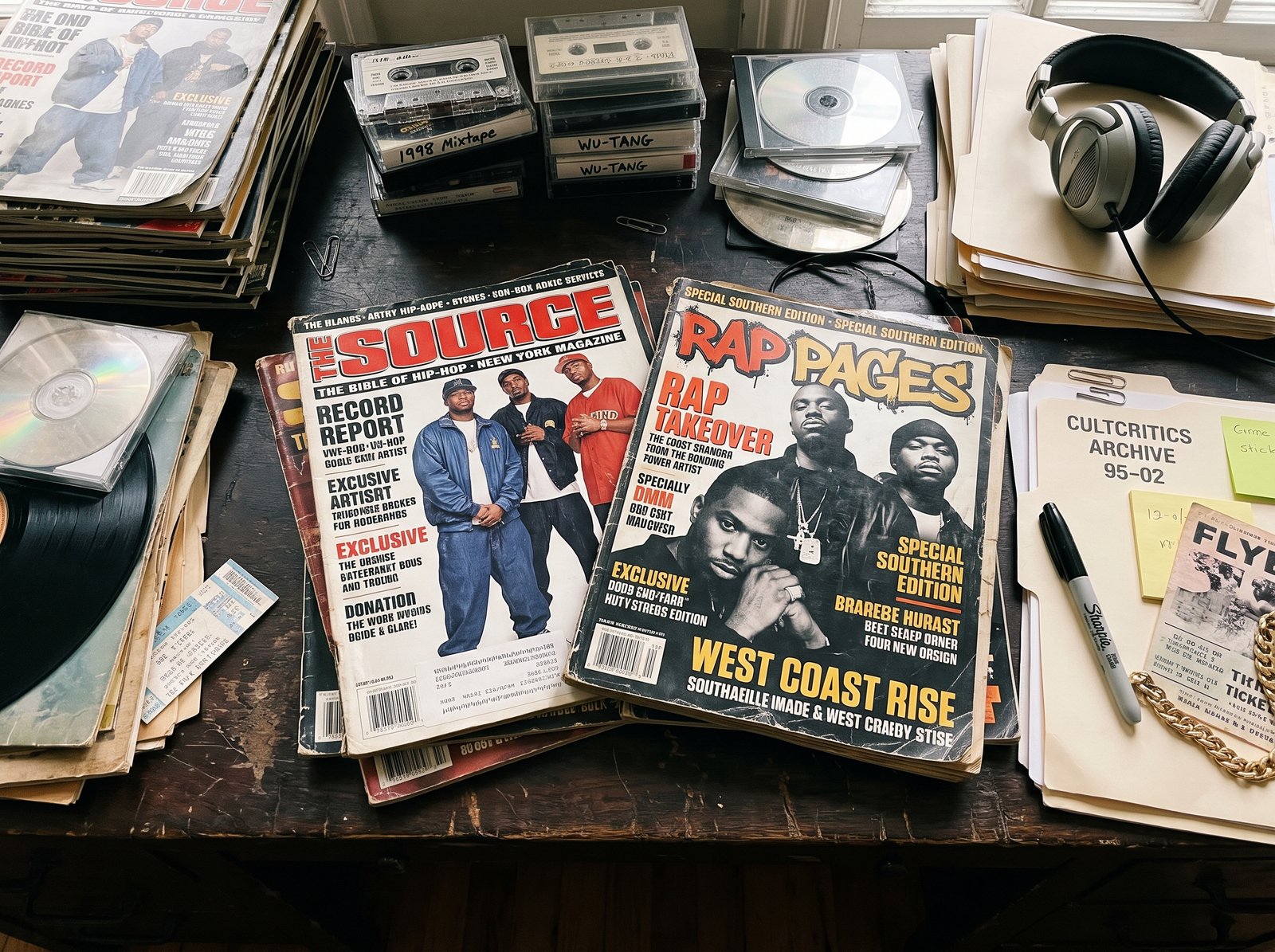
Before algorithms dictated taste and streaming playlists flattened regional identity into a single global feed, hip-hop mythology was forged in ink, glossy paper stock, and staple-bound newsstand combat. In the late 1990s, walking up to a corner bodega or tower record rack meant confronting two competing visions of the culture: the East Coast institutional authority of The Source and the unruly, art-forward West Coast and regional rebellion of Rap Pages.
Today, surviving copies from that era have evolved from four-dollar commuter reads into heavily hunted artifacts within the 1990s hip-hop archive, prized by collectors for capturing the exact moment rap transitioned from street reporting into a multi-billion-dollar global empire.
The Newsstand Gatekeepers
Founded in 1988 out of a Harvard dorm room by David Mays and Jon Shecter before relocating to New York City, The Source quickly billed itself as the “Bible of Hip-Hop.” Throughout the mid-to-late 1990s, its editorial pages operated as the supreme court of the genre. Receiving a coveted five-mic rating in the “Record Report” guaranteed platinum plaques and historical canonization, while a single paragraph in the “Unsigned Hype” column could plucked an unknown lyricist out of obscurity overnight.
Nowhere is that kingmaking power more tangible than in the March 1998 Issue #102 of The Source. While Bad Boy Records stars Ma$e and The LOX commanded the glossy front cover in metallic shiny suits, an interior “Unsigned Hype” column introduced a bleached-blond Detroit underground battle rapper named Eminem—the exact piece of print media that landed on Dr. Dre’s desk and altered the trajectory of modern pop music.
Browsing a curated The Source collection reveals how deliberately the publication balanced street credibility with high-stakes journalism. When N.W.A architect Eric Wright passed away in 1995, the magazine paused coastal hostilities to publish its historic June 1995 Eazy-E tribute, cementing the cover as a permanent cultural memorial. Three years later, issues like the May 1998 Ice Cube cover and the May 1999 Nas issue documented veterans fighting to maintain lyrical purism as the turn of the millennium approached.
Coastal Print Rebellion
While The Source guarded the New York orthodoxy, Beverly Hills publisher Larry Flynt launched Rap Pages in 1991 as an unapologetic counterweight. If The Source was hip-hop’s newspaper of record, Rap Pages was its avant-garde art journal and regional megaphone. Rather than treating Los Angeles, Oakland, Houston, Atlanta, and New Orleans as secondary markets, the editors of Rap Pages put regional pioneers directly on the front cover with bold illustration, experimental photography, and long-form cultural essays.
Examining preserved issues inside the Rap Pages archive shows a publication fearless enough to champion sonic architects whom mainstream East Coast media routinely overlooked. The March 1998 DJ Quik issue celebrated Compton G-funk production mastery alongside Gang Starr and Hieroglyphics, while the April 1999 E-40 cover gave Bay Area independent hustle and mobb music national newsstand visibility alongside Krayzie Bone and Jurassic 5.
Southern Empire Aesthetics
By 1999, the print war between the two magazines collided with the most disruptive business shift in music history: the rise of Southern independent empires. Master P’s No Limit Records and Birdman’s Cash Money Records bypassed traditional coastal gatekeepers entirely, using relentless release schedules and Pen & Pixel diamond-encrusted graphics to hijack the newsstand.
Rap Pages documented this Southern takeover in real time. Its February 1999 Cash Money cover captured Lil Wayne and the Hot Boys right as New Orleans bounce and bling entered the national lexicon. Months later, the July 1999 Snoop Dogg issue broke the seismic West Coast news that Snoop was reuniting with Dr. Dre for the 2001 sessions while sharing interior pages with OutKast, Eightball & MJG, and No Limit’s Young Bleed.
Not to be outflanked at the checkout aisle, The Source leaned heavily into the Southern gold rush as well. Its April 1999 Issue #115 placed No Limit lieutenants C-Murder and Silkk the Shocker front and center, proving that even the strictest East Coast editorial room could no longer ignore the commercial gravity of New Orleans tank dogs.
Monumental Issue Artifacts
What makes late-1990s hip-hop magazines so compelling to modern archivists is how differently the two publications framed the exact same cultural flashpoints. Consider the summer of 1999, when The Slim Shady LP turned Eminem from an underground curiosity into a mainstream lightning rod. The rare June 1999 Rap Pages cover photographed him at peak irreverence alongside features on Nas and DMX, capturing the raw friction of 1999 just months before Rap Pages ceased publication.
Because paper was never meant to survive three decades of basement humidity, bedroom wall tape, and spine-cracking backpacks, intact copies from this era have become remarkably scarce. Flipping through an original issue in the vintage print archive offers something no digital PDF or Wikipedia summary can replicate: the full sensory ecosystem of the era. Between the feature interviews sit full-page advertisements for Lugz boots, Wu-Wear denim, Mecca USA, St. Ides malt liquor, and mail-order cassette clubs—a frozen blueprint of how street subculture financed and dressed itself before corporate consolidation.
Preserving Uncut Provenance
For collectors building a physical library of Golden Era history, value comes down to completeness and honest provenance. In the late 1990s, teenagers routinely razored out centerfold posters, clipped subscription cards, and tore cover portraits off the staples to plaster locker doors. Finding a 100% complete, uncut reading copy—where every page, spine staple, and period ad remains bound just as it left the printer—is what separates true archival holdings from beat-up flea market paper.